In 2026, customer expectations are no longer defined by speed alone—they are shaped by personalisation, real-time engagement, and seamless experiences across every touchpoint.
For growing businesses, this shift presents both an opportunity and a challenge.
While platforms like Salesforce offer powerful capabilities, many organisations still struggle to unlock real value. The reason is simple:
Salesforce is often implemented as a tool—not as a business strategy.
To succeed in today’s environment, companies must rethink their approach. Salesforce is no longer just a CRM—it is a scalable, AI-powered business engine that can transform how organisations operate, engage customers, and drive growth.
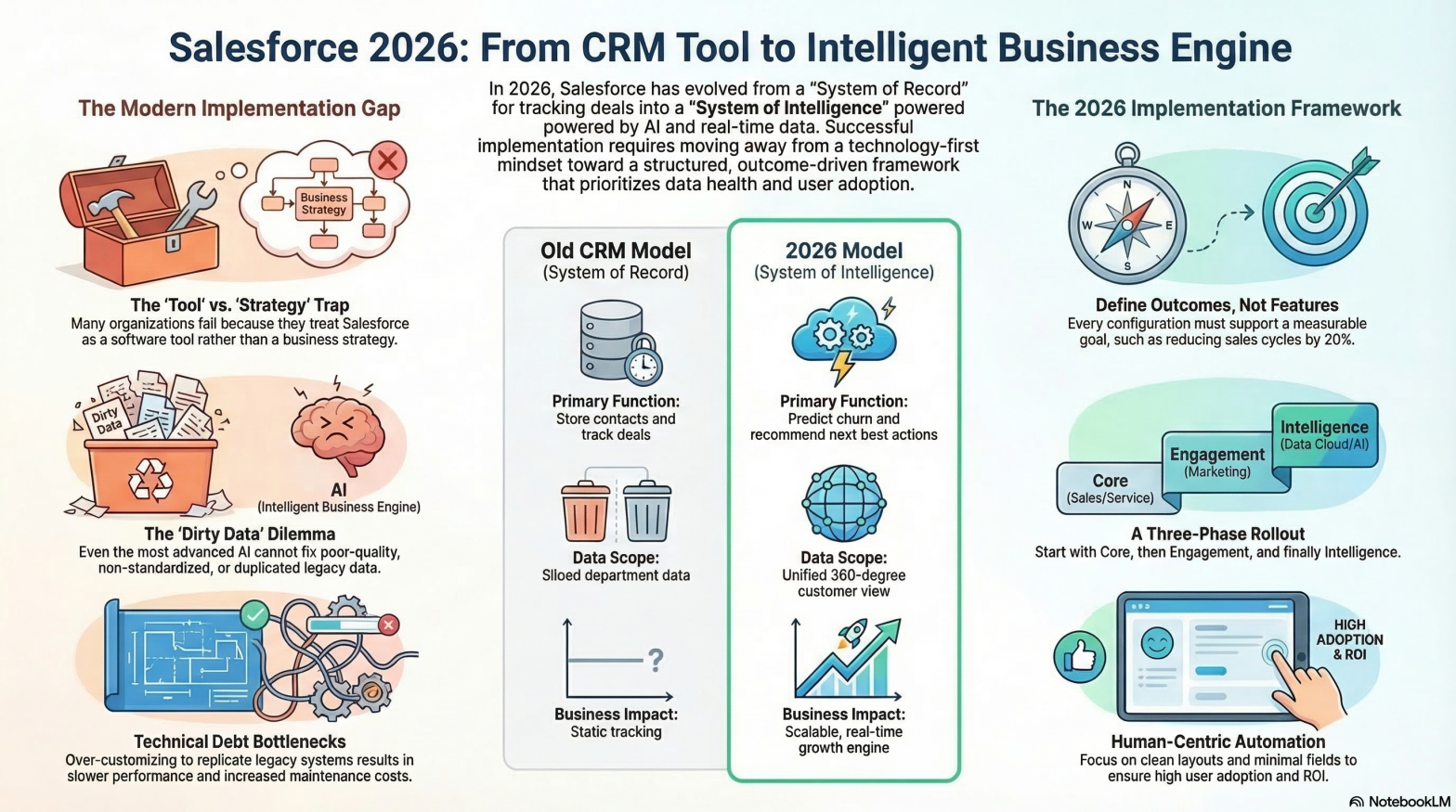
The 2026 Shift: From CRM to Intelligent Business Engine
For years, Salesforce was seen as a System of Record—a place to store contacts and track deals.
That model is now outdated.
In 2026, Salesforce has evolved into a System of Intelligence, driven by three key pillars:
- End-to-End Business Transformation
Salesforce is no longer limited to sales teams. It now connects:
- Marketing
- Sales
- Customer Service
- Commerce
- Finance
This creates a single source of truth, enabling organisations to operate as one unified system rather than siloed departments.
- AI-Driven Insights and Automation
With advancements in AI capabilities like Einstein and Agentforce:
- Systems recommend the next best action
- Customer service interactions can be automated
- Churn risks can be predicted before they occur
👉 Salesforce doesn’t just store data—it actively helps you make smarter decisions.
- Unified Data Architecture
With Data Cloud at the centre, organisations can now process massive volumes of real-time data to build a true 360-degree customer view.
This allows businesses to:
- Deliver hyper-personalised experiences
- Improve forecasting accuracy
- Drive data-driven decision-making
Why Implementations Fail: Avoiding the Pitfalls of the Past
Despite access to advanced technology, many organisations fail to achieve expected ROI.
Understanding these pitfalls is critical.
- Lack of Clear Business Objectives
Many implementations begin with a technology-first mindset.
Leaders focus on features rather than outcomes.
But without clear success metrics:
- Progress cannot be measured
- ROI cannot be proven
- Optimisation becomes impossible
If you cannot measure it, you cannot improve it.
- Over-Customisation and Technical Debt
In an attempt to replicate legacy systems, organisations often over-engineer Salesforce.
This results in:
- Slower performance
- Increased maintenance cost
- Complex user experience
Instead of enabling growth, the system becomes a bottleneck.
- The “Dirty Data” Dilemma
Migrating poor-quality data into Salesforce is one of the most common mistakes.
The result?
- Inaccurate reports
- Failed automations
- Loss of user trust
Even the most advanced AI cannot fix bad data.
- Low User Adoption
If users find Salesforce difficult to use, they simply won’t use it.
This leads to:
- Incomplete data
- Poor reporting
- Wasted investment
Adoption is not optional—it is critical to success.
The 10-Point Salesforce Implementation Framework for 2026
To succeed in 2026, businesses must follow a structured, strategy-driven approach.
- Define Outcomes, Not Features
Start with business goals:
- “Reduce sales cycle by 20%”
- “Improve conversion rates by 15%”
Every configuration should support a measurable outcome.
- Strategic Product Selection
Avoid buying everything at once.
Adopt a phased approach:
- Phase 1: Core (Sales & Service)
- Phase 2: Engagement (Marketing & Experience)
- Phase 3: Intelligence (Data Cloud & AI)
This ensures better adoption and lower risk.
- Designing for Scalability
Your data model is your foundation.
A scalable architecture ensures:
- Future growth
- Smooth integrations
- High performance
Fixing architecture later is expensive and disruptive.
- Rigorous Data Governance
Before migration:
- Deduplicate records
- Standardise formats
- Define ownership
Clean data is essential for automation and AI success.
- Building Human-Centric Automation
Automation should support users—not overwhelm them.
In 2026:
- Focus on intelligent automation
- Combine workflows with AI
- Keep processes simple
- The Integration Ecosystem
Salesforce must integrate with:
- ERP systems
- Finance platforms
- Marketing tools
Without integration, you create data silos.
- Prioritising User Experience (UX)
User adoption drives ROI.
Focus on:
- Clean layouts
- Minimal fields
- Mobile usability
- In-app guidance
If users love it, they will use it.
- Security and Compliance
With increasing regulations:
- Implement role-based access
- Ensure data protection
- Conduct regular audits
Security is a business priority, not just IT responsibility.
- Establishing AI Readiness
AI is only as good as your data.
To prepare:
- Ensure structured processes
- Maintain clean historical data
- Standardise workflows
Without this, AI outputs will be unreliable.
- Continuous Optimisation Cycle
Go-live is just the beginning.
To sustain value:
- Monitor usage
- Improve processes
- Adapt to new features
Continuous optimisation drives long-term ROI.
The Tangible Business Value of a Strategic Approach
When implemented strategically, Salesforce delivers real business impact:
- Faster time-to-value
- Improved operational efficiency
- Data-driven decision making
- Lower total cost of ownership
- Enhanced customer experience
Salesforce becomes a growth engine, not just a system.
Why Partner with Dotsquares?
At Dotsquares, we go beyond implementation—we align Salesforce with your business goals and growth strategy.
Our approach includes:
- Business-first consulting
- End-to-end implementation
- Data governance and migration
- AI enablement and automation
- Ongoing optimisation and support
With decades of experience, we ensure your Salesforce platform is:
✔ Scalable
✔ Secure
✔ AI-ready
✔ Business-driven
Conclusion
In 2026, Salesforce implementation is no longer a technical project—it is a strategic business decision.
Organisations that approach it with clarity, structure, and the right partner will unlock:
- Higher ROI
- Better customer experiences
- Sustainable growth
The question is not whether you should implement Salesforce—but whether your strategy is strong enough to maximise its potential.
Ready to Get Started?
Is your Salesforce strategy ready for the challenges of 2026?
Contact Dotsquares today for a comprehensive Salesforce Audit and Strategy Session
and take the first step toward building a future-ready business platform.

