Salesforce is often the central system powering customer service operations, sensitive customer data, and critical business workflows. As organisations grow, evolve, and integrate new tools, Salesforce environments naturally become more complex.
Over time, this complexity can introduce security gaps, operational inefficiencies, compliance risks, and hidden costs—often without clear visibility at the leadership level.
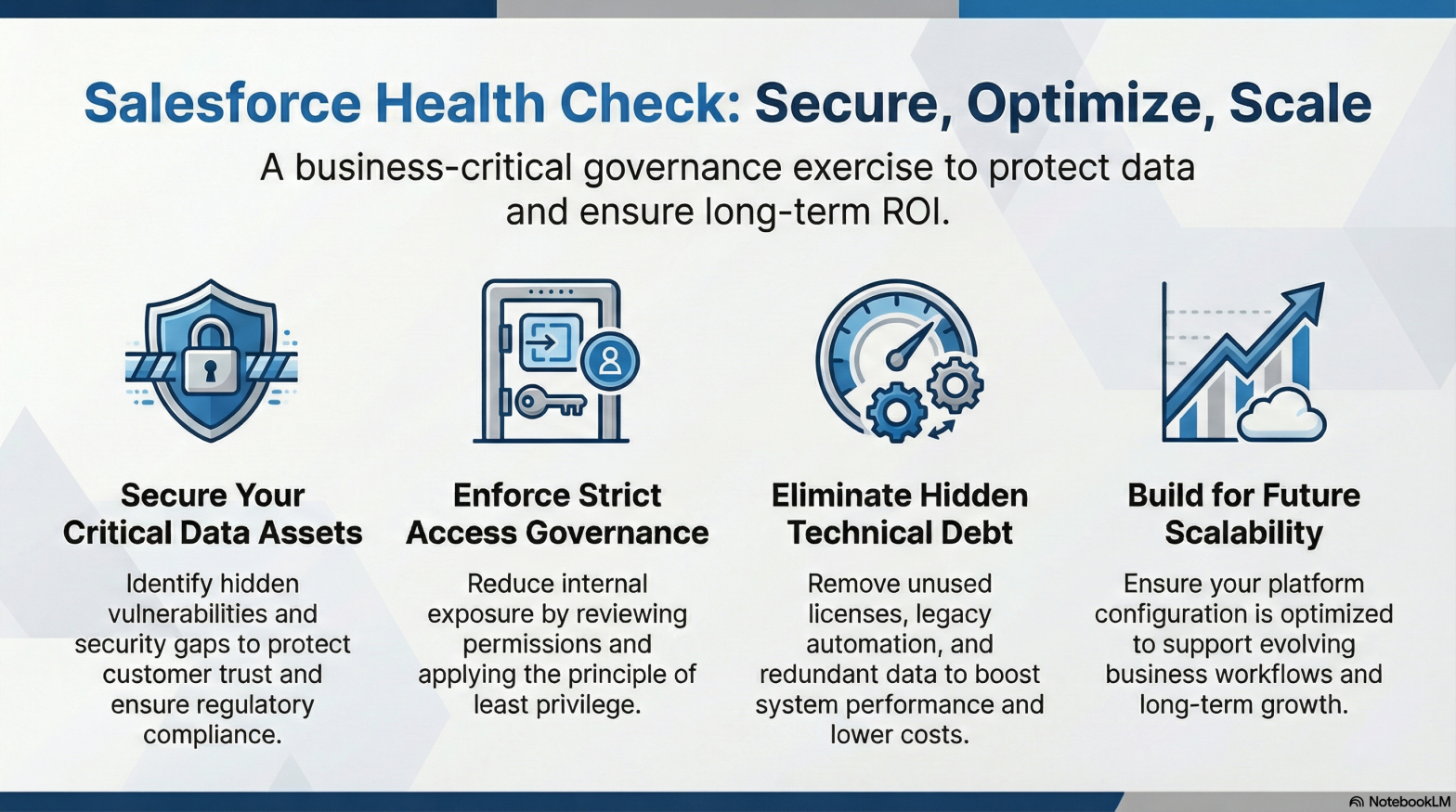
This is why a Salesforce Health Check is no longer just a technical review. It is a business-critical governance exercise that helps organisations protect data, optimise performance, and ensure their Salesforce investment continues to support long-term growth.
Salesforce Health Check: Executive Summary
A Salesforce Health Check helps leadership teams:
- Gain a clear view of Salesforce security, risk exposure, and configuration health
- Identify hidden vulnerabilities that may impact compliance and customer trust
- Reduce long-term Salesforce operational and remediation costs
- Ensure the platform remains scalable, secure, and business-ready
What Is a Salesforce Health Check and Why Does It Matter?
A Salesforce Health Check is a structured assessment of your Salesforce org against Salesforce-recommended best practices, with a strong focus on security, access control, governance, and configuration quality.
While Salesforce offers a built-in Health Check feature, a comprehensive health check goes further—reviewing how the platform is actually being used across the business and where risks or inefficiencies may exist.
For business leaders, a Salesforce Health Check answers critical questions:
- Is our customer and operational data adequately protected?
- Are we exposed to compliance or audit risks?
- Is Salesforce configured to support future growth?
- Are we paying for inefficiencies we cannot see?
Why Salesforce Health Checks Are Essential for Business Leaders
Many Salesforce orgs appear to function well on the surface. However, serious issues often surface only during audits, security incidents, or performance failures—when remediation is expensive and disruptive.
Regular Salesforce Health Checks help organisations:
- Reduce exposure to data breaches and regulatory penalties
- Protect brand reputation and customer trust
- Improve system performance and user productivity
- Gain leadership-level visibility into platform risk
- Maintain alignment with evolving compliance requirements
In enterprise environments, Salesforce Health Checks act as a preventive risk-management tool, not a reactive fix.
Key Areas Reviewed in a Salesforce Health Check
A robust Salesforce Health Check evaluates multiple layers of the platform, translating technical findings into clear business-impact insights.
Security and Access Controls
Reviews password policies, authentication methods, MFA enforcement, session security, and login restrictions. Weak controls here can directly expose customer data and regulatory compliance.
User Permissions and Governance
Identifies excessive admin access, over-permissioned users, inactive users retaining access, and role hierarchy risks—one of the most common sources of internal security exposure.
Data Visibility and Compliance Alignment
Evaluates organisation-wide defaults, sharing rules, and data access controls to ensure information visibility aligns with privacy regulations and internal policies.
Platform Configuration and System Hygiene
Highlights deprecated features, unused licenses, inactive users, API usage risks, and configuration inconsistencies that inflate cost and reduce stability.
Customisation and Technical Debt
Assesses unused objects, legacy automation, conflicting workflows, and redundant validation rules that impact performance and slow innovation.
Salesforce Security Health Check vs Full Salesforce Health Check
A Salesforce Security Health Check focuses primarily on authentication and security settings, offering a high-level risk snapshot.
A Full Salesforce Health Check expands the scope to include:
- Access governance and identity risk
- Configuration and automation quality
- Integration exposure
- Usage, adoption, and scalability readiness
For enterprise organisations, a full health check delivers strategic decision-making insight, not just a technical score.
Best Practices for Maintaining a Healthy Salesforce Org
Maintaining a healthy Salesforce org is not a one-time exercise—it requires continuous governance, disciplined execution, and proactive optimisation. Following proven best practices helps organisations reduce risk, improve operational efficiency, and ensure long-term scalability.
Below are Dotsquares-recommended best practices for keeping Salesforce secure, stable, and high-performing:
| Best Practice | Description |
|---|---|
| Adopt Standardised Development Practices | Establish consistent coding and configuration standards to ensure scalable, maintainable customisations and avoid performance bottlenecks. |
| Prioritise Issues Based on Business Impact | Classify findings by severity, risk exposure, and operational impact so critical vulnerabilities are addressed first. |
| Enforce Strong Access Controls and Regular Permission Reviews | Apply the principle of least privilege by reviewing user access regularly and removing unnecessary permissions. |
| Conduct Ongoing Security and Compliance Reviews | Perform periodic audits to validate security settings, identify compliance gaps, and meet regulatory obligations. |
| Optimise Data Storage and Reduce Redundancy | Archive outdated records, remove unused fields, and clean redundant customisations to improve performance and control costs. |
| Monitor System Activity and Platform Usage | Review logs, API usage, and system behaviour to identify anomalies, inefficiencies, or emerging risks early. |
| Leverage Automation for Platform Maintenance | Automate routine tasks such as monitoring, clean-ups, and alerts to maintain consistent platform health with minimal manual effort. |
Enhancing Salesforce Health Checks with a Partner-Led Approach
Salesforce’s native Health Check tool provides a useful baseline. However, enterprise organisations often require deeper visibility, prioritisation, and business-context insights.
At Dotsquares, we enhance Salesforce Health Checks through a comprehensive, partner-led approach that includes:
- Holistic Security and Risk Assessment aligned to business governance
- Access and Identity Governance Reviews to reduce internal exposure
- Proactive Risk Identification across users, data, and integrations
- Data Exposure and Sharing Analysis to protect sensitive information
- Third-Party App and Integration Reviews to minimise external risk
This approach transforms health checks into a continuous governance framework, not a one-off review.
Business Benefits of a Regular Salesforce Health Check
Organisations that conduct regular Salesforce Health Checks benefit from:
- Reduced compliance and security exposure
- Improved system performance and reliability
- Lower total cost of ownership
- Increased user confidence and adoption
- Stronger long-term Salesforce ROI
A well-governed Salesforce org becomes a competitive advantage—not a liability.
Conclusion: Salesforce Health Check as a Strategic Safeguard
Salesforce Health Checks should not be treated as one-time technical exercises. They are an essential part of enterprise risk management and platform governance.
By proactively assessing security, access, and configuration health, organisations protect customer trust, ensure compliance, and keep Salesforce aligned with business growth.
With the right expertise and a structured approach, a Salesforce Health Check becomes a strategic safeguard—ensuring your CRM continues to support, not constrain, your organisation.
Talk to Our Salesforce Experts
If your Salesforce org supports critical customer or operational data, a regular Health Check is no longer optional.
Talk to our Salesforce experts at Dotsquares to gain clarity, confidence, and control over your Salesforce environment.

